Accessibility by default
Color-vision-safe modes, contrast, keyboard, touch, reduced motion, and text adaptation begin as system expectations.
 DASH XA XERXES SI SYSTEM
XERXES SIMAIN SITE ↗
DASH XA XERXES SI SYSTEM
XERXES SIMAIN SITE ↗
Dash X is where those standards become visible. SIDE is the standards-first development system by XERXES SI that carries the broader control, verification, accessibility, security, evidence, and packaging philosophy.
Dash X is a visible demonstration of a standards-bearing development model. Accessibility, semantic modules, integration boundaries, security posture, human authority, and evidence requirements are not meant to be rediscovered from scratch for every interface.
Color-vision-safe modes, contrast, keyboard, touch, reduced motion, and text adaptation begin as system expectations.
Reusable surfaces carry stable identity and semantic behavior instead of becoming arbitrary rectangles.
Normalized records and collector boundaries keep transport and presentation from collapsing into one privileged tangle.
Decisions, protected areas, verification, rollback, and provenance stay visible rather than being implied.
Dash X demonstrates a central SIDE idea: a development package can carry more than screens. It can carry reusable interface rules, accessibility expectations, module semantics, integration contracts, security boundaries, documentation, and verification discipline so each new operational world begins from a governed baseline instead of rediscovering fundamentals.
The demonstrated environment originated in the internal AIDE lineage. That standards-first development model is now carried forward in SIDE by XERXES SI. Dash X is an operational proof surface; the complete SIDE platform story is live at xside.xerxessi.com ↗.
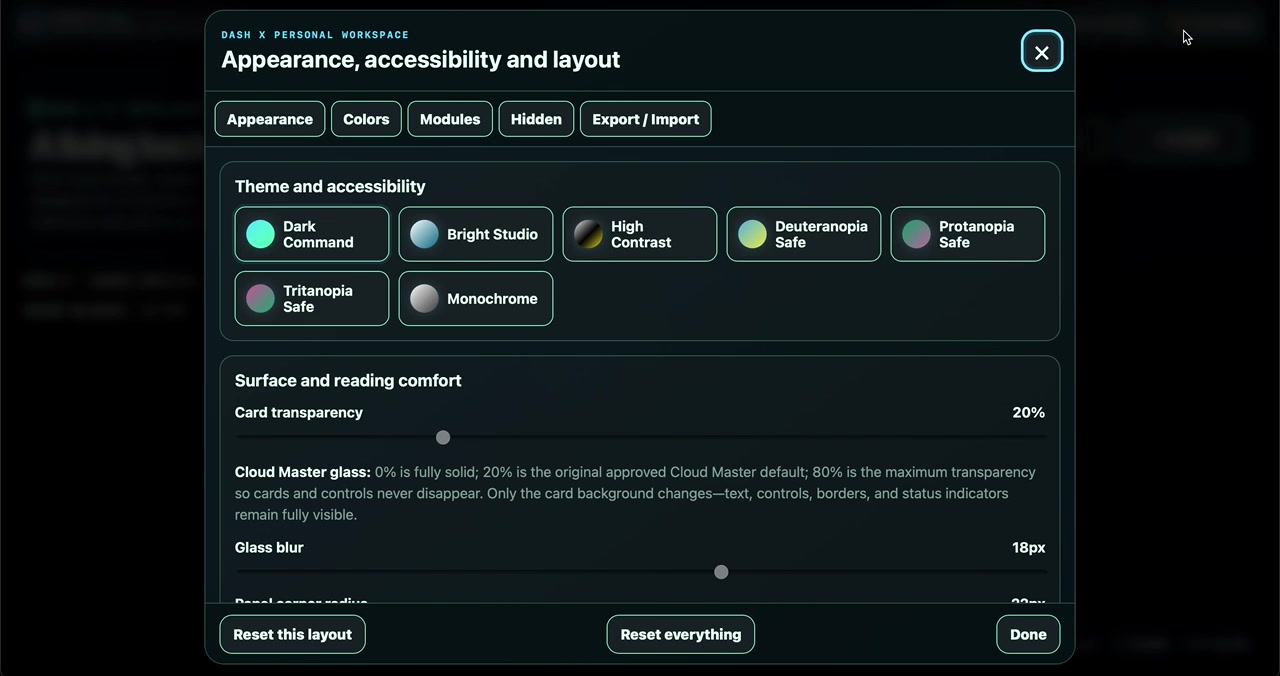
The demonstrated environment exposes high-contrast, monochrome, and color-vision-safe modes alongside layout, transparency, blur, radius, spacing, and text-scale controls. The point is not a settings menu—it is that accessibility and operator adaptation are treated as reusable system capabilities.
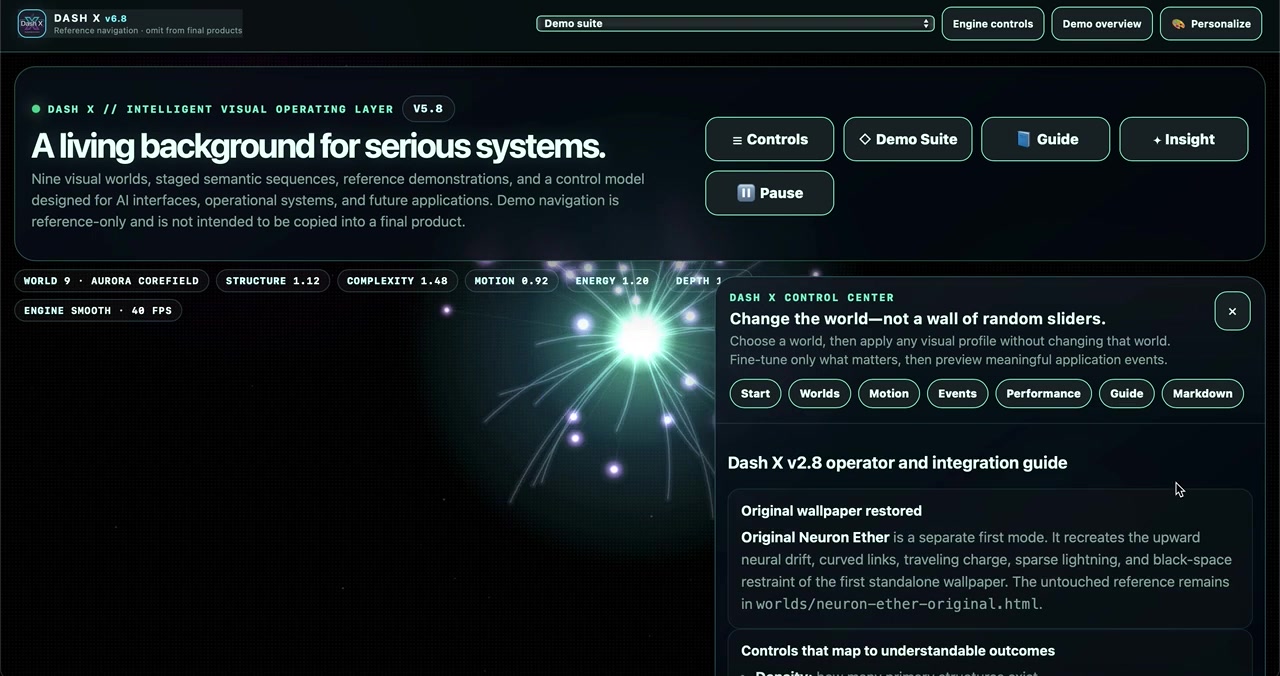
Guidance, configuration, embedded documentation, and reference behavior live with the environment. That reduces the gap between a standard written somewhere else and a standard the builder or operator can actually see while working.
Shared color, spacing, surface, and interaction conventions allow different operational worlds to remain coherent while still adapting to the needs of their domain.
Cards and modules are not arbitrary rectangles. Their roles, locked states, movement behavior, visibility, integration surface, and status semantics can be standardized so new work begins from known contracts.
Established design systems show the value of reusable components and accessibility foundations. SIDE pushes the concept further: the package is intended to carry interface standards together with development methodology, integration expectations, security posture, documentation, and package integrity. Dash X is where an investor can see that philosophy operating rather than merely read about it. Explore XERXES SIDE ↗
This page intentionally stops at the layer needed to understand Dash X. The deeper standards-first methodology, package model, development controls, verification discipline, and platform story now live on the dedicated SIDE site.